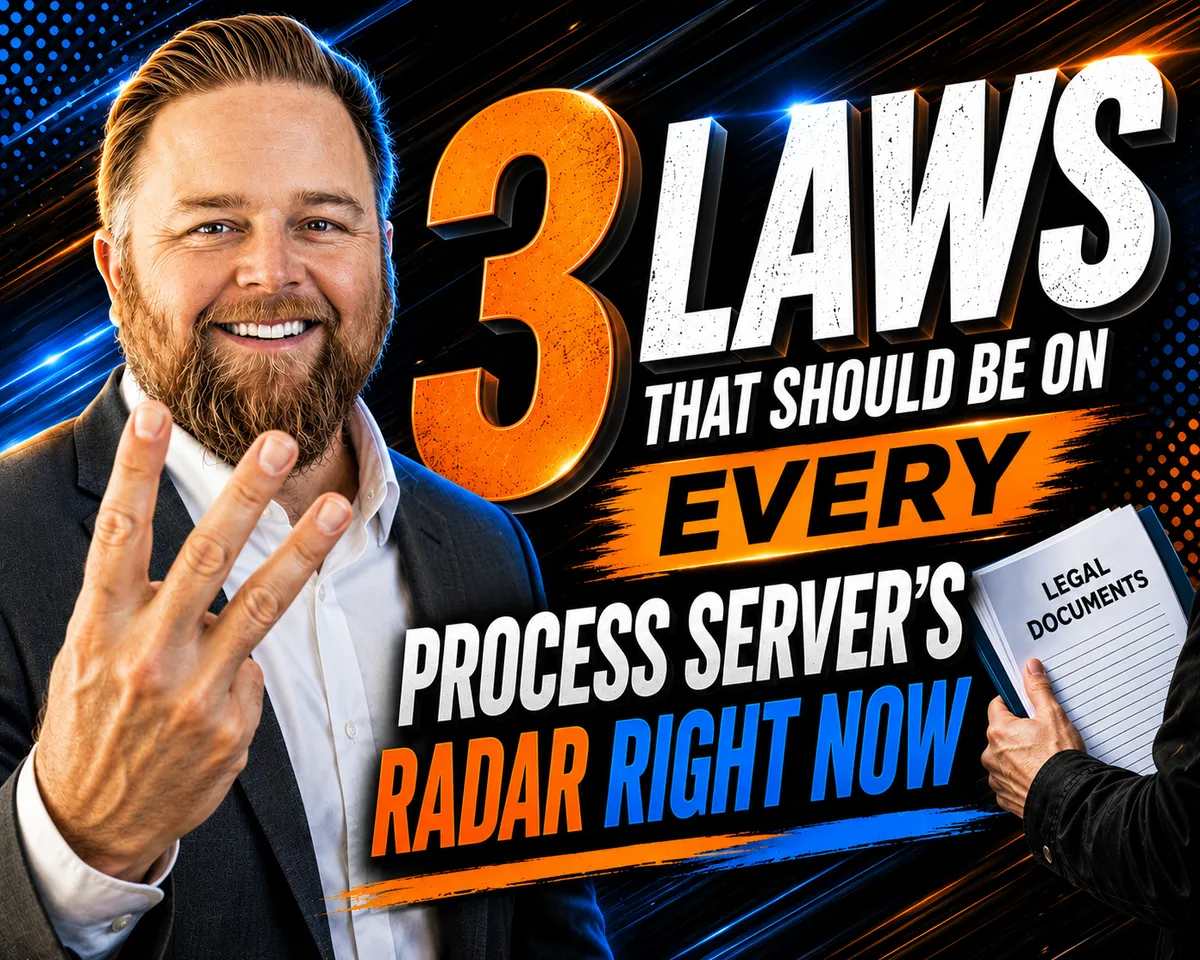
Three Laws That Should Be on Every Process Server's Radar Right Now
By Mighty Mike Reid
Three New Process Server Law Developments Every Legal Professional Should Watch in 2026
Process serving remains one of the most important functions within the legal system. Every lawsuit, subpoena, and legal proceeding depends on proper notification to the parties involved. As courts and legislatures continue to modernize service requirements, process servers, attorneys, and law firms must stay informed about evolving legal standards.
Recent process serving legislative changes in Louisiana, Michigan, and California could significantly impact how service is completed, documented, and challenged. These developments highlight the importance of understanding current service of process regulations and maintaining compliance with changing legal requirements.
Why Process Server Laws Continue to Evolve
Legislatures and courts regularly evaluate process server legal requirements to improve efficiency, reduce unnecessary barriers, and address challenges created by modern communication methods and secured residential buildings.
For legal professionals, staying informed about amendments in process serving is essential. A single procedural error can result in delays, motions to quash service, or even dismissal of legal actions. The latest legal updates for process servers demonstrate how quickly service requirements can change.
Louisiana HB 683: Major Reform for Private Process Servers
One of the most significant process server laws 2023 discussions centered around modernization efforts across several states. In 2026, Louisiana may be taking a substantial step forward through House Bill 683.
On March 9, 2026, Louisiana House Bill 683, sponsored by Representative Jay Galle, was referred to the House Committee on Civil Law and Procedure. The legislation proposes two major reforms that could simplify service procedures throughout the state.
Elimination of Notarized Returns
The bill would remove the requirement that service returns be notarized. Under the proposed legislation, a standard return of service would be sufficient.
This change could:
Reduce administrative costs
Eliminate scheduling delays associated with notarization
Streamline filing procedures
Improve efficiency for private process servers
For professionals handling high volumes of service, this amendment could significantly reduce unnecessary paperwork while maintaining accountability.
Removal of the Sheriff-First Waiting Period
HB 683 would also eliminate Louisiana's mandatory five-day waiting period that currently requires parties to attempt service through the sheriff before utilizing private process servers for subpoena service.
If enacted, the change would:
Accelerate service timelines
Provide greater flexibility for litigants
Increase access to private process serving services
Reduce delays in time-sensitive matters
Louisiana process servers and legal professionals should closely monitor the bill as it advances through committee review.
Michigan Federal Court Clarifies Electronic Service Standards
As electronic service of process becomes more common, courts continue to define the boundaries of acceptable digital communication.
In Drew's Girl Productions v. Hill, U.S. District Judge F. Kay Behm addressed whether a text message response could satisfy Michigan's signed acknowledgment requirement for service.
The court concluded that an unsigned text message does not constitute a legally valid signed acknowledgment under Michigan Court Rule 2.105(A)(2).
Why the Decision Matters
Many process servers encounter situations where recipients respond informally through text messages or social media platforms. While these communications may confirm receipt, they do not necessarily satisfy statutory service requirements.
The ruling reinforces several important principles:
A phone number alone is not a signature.
Informal acknowledgments may not establish valid service.
Courts continue to require compliance with formal procedural standards.
Digital communications must satisfy existing legal requirements before they can serve as proof of service.
As jurisdictions expand electronic service of process options, process servers must ensure that digital interactions meet statutory and court-imposed requirements.
California AB 1742: Addressing the Locked Building Challenge
California lawmakers are attempting to solve one of the most persistent obstacles facing urban process servers: restricted-access buildings.
Assembly Bill 1742 proposes adding Section 415.70 to the California Code of Civil Procedure.
Proposed Solution for Access-Controlled Buildings
Under the proposed legislation, when security personnel or building management refuse entry, a process server could complete substituted service by serving the individual who controls access to the property.
For process servers operating in large metropolitan areas, this proposal could have significant implications.
Potential benefits include:
Reduced service delays
Greater certainty when encountering access restrictions
Improved access to defendants residing in secured communities
Fewer costly repeat service attempts
The bill represents one of the more innovative recent amendments in process serving and reflects lawmakers' recognition of practical challenges faced by servers in modern residential and commercial properties.
The Continuing Impact of Privacy Laws on Process Servers
Beyond these legislative developments, privacy laws for process servers remain an important area of compliance.
Process servers routinely handle sensitive personal information, including:
Residential addresses
Employment information
Court filings
Contact information
Financial and legal records
Many state privacy laws now require stronger safeguards for collecting, storing, and transmitting personal data. Process serving companies should regularly review data protection policies and security practices to ensure ongoing compliance.
Best Practices for Process Server Compliance
To remain compliant with changing state process server laws, professionals should adopt a proactive approach to legal education and procedural updates.
Recommended practices include:
Monitoring legislative developments in active jurisdictions
Reviewing court decisions affecting service requirements
Participating in professional associations and continuing education
Maintaining accurate documentation procedures
Understanding state-specific service of process regulations
Implementing secure data management systems
Compliance is no longer limited to successful delivery of documents. Modern process serving requires understanding privacy requirements, digital communication standards, and evolving procedural rules.
Looking Ahead
The developments in Louisiana, Michigan, and California demonstrate how quickly the legal landscape can change. Whether through legislative reform, judicial interpretation, or technological adaptation, process serving continues to evolve alongside the broader legal system.
Professionals who stay informed about process server laws 2023 trends, current legal updates for process servers, and emerging amendments in process serving will be better positioned to provide reliable, defensible service.
As lawmakers continue evaluating service procedures and courts address new technologies, staying educated remains one of the most valuable tools available to every process server.
Stay sharp. Stay informed. Live Mighty!
Read the full article at www.mightyprocessserver.com
This article is published by Process Server Daily, powered by MightyAutomation.ai, the leader in legal support intelligence.