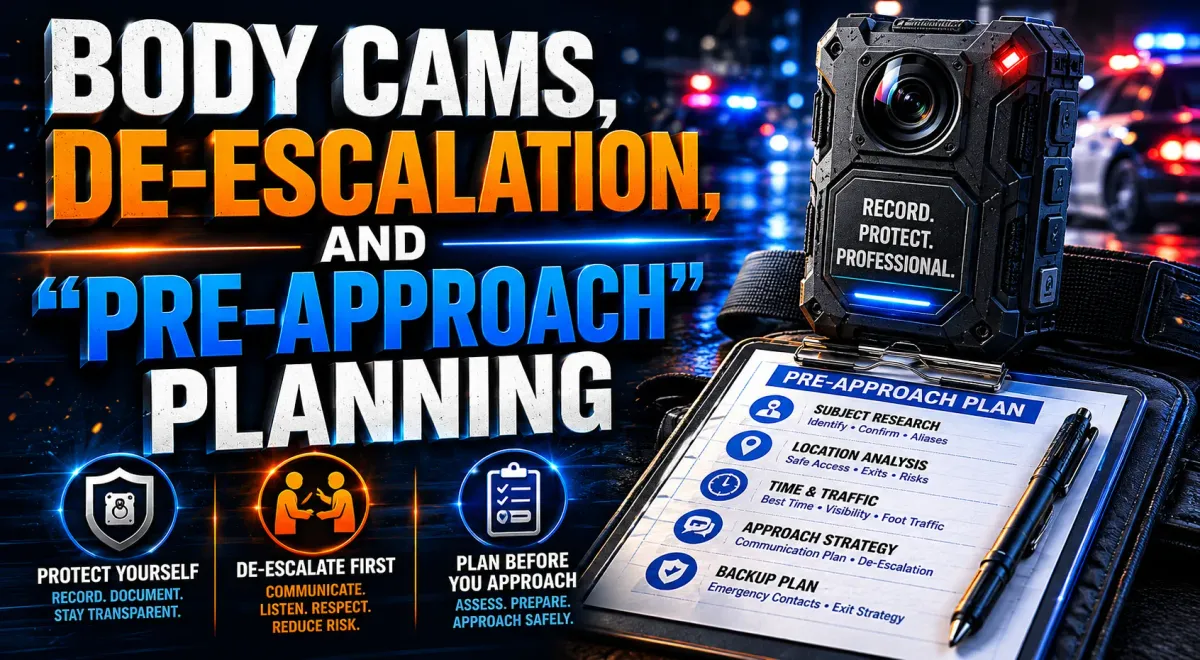
Body Cams, De‑Escalation, and “Pre‑Approach” Planning
By Mighty Mike Reid
Body Cams, De-Escalation, and Pre-Approach Planning: Building a Safety Stack for Modern Process Servers
Process serving is often viewed as a straightforward profession. In reality, even routine service attempts can become unpredictable within moments. Process servers regularly enter situations involving legal disputes, emotional stress, financial pressures, family conflicts, and workplace tensions.
Because of this reality, safety should never be an afterthought.
The most successful professionals rely on a repeatable safety stack that combines preparation, documentation, communication skills, and technology. Body cameras, de-escalation techniques, and pre-approach planning have become essential tools for reducing risk while improving the quality and defensibility of service attempts.
Just as importantly, strong documentation protects process servers in the field and in court.
Introduction to Body Cams in Process Serving
Technology continues to reshape the legal services industry, and one of the most impactful developments is the growing use of body cams for process servers.
Originally associated with law enforcement, body cameras are increasingly being adopted by process servers as part of broader risk management and documentation strategies.
These devices help create objective records of interactions, support affidavit accuracy, and provide valuable evidence if a service attempt is later challenged.
Combined with proper training and operational policies, body cameras have become a valuable component of modern technology in process serving.
Why Process Serving Requires a Safety Mindset
Every service attempt involves uncertainty.
Recipients may:
Be surprised by the visit
Misunderstand the purpose of service
React emotionally
Become confrontational
Attempt to evade service
These realities make preparation essential.
The goal is not simply to complete service. The goal is to complete service safely, professionally, and with documentation that can withstand scrutiny.
Pre-Approach Planning for Process Servers
One of the most effective ways to reduce risk is through pre-approach planning for process servers.
Preparation before arriving at a location can significantly improve both safety and service outcomes.
Confirm Identity and Address Information
Review:
Full name variations
Known aliases
Address details
Service instructions
Property layout when available
Verifying information beforehand helps avoid unnecessary mistakes and confusion.
Assess the Environment
Before approaching, observe factors such as:
Lighting conditions
Parking options
Visibility
Potential exit routes
Signs of ongoing conflict
A thoughtful pre-approach strategy allows process servers to make informed decisions before engaging with recipients.
Know When to Reset
If conditions appear unsafe, such as active arguments, visible intoxication, threatening behavior, or aggressive animals, it may be appropriate to leave and attempt service later.
Professional judgment is an important part of effective risk management.
Body Cameras as Safety and Documentation Tools
The conversation around body cam benefits for process servers often focuses on deterrence. While that is certainly valuable, documentation may be an even greater benefit.
Objective Evidence
Body camera footage can provide:
Time-stamped records
Visual confirmation of interactions
Documentation of service attempts
Evidence supporting affidavits
Protection against false allegations
When combined with detailed field notes, video recordings help strengthen the credibility of service records.
Supporting Defensible Documentation
Disputes occasionally arise regarding service attempts, recipient conduct, or conversations that occurred during service.
In these situations, video evidence can provide clarity and reduce reliance on conflicting recollections.
This makes body cameras an important addition to modern process serving tools.
De-Escalation Techniques in Process Serving
Technical skills are important, but communication skills often determine the outcome of an interaction.
Effective de-escalation techniques in process serving can reduce tension and help prevent confrontations from escalating.
Stay Calm and Professional
Recipients often mirror the emotional tone of the interaction.
Maintaining a calm demeanor can help lower stress levels and encourage cooperation.
Use Simple Language
Avoid legal jargon and unnecessary explanations.
Clear and concise communication reduces confusion and minimizes opportunities for conflict.
Listen Actively
Allowing individuals to express concerns without interruption can help reduce frustration.
Active listening is one of the most effective forms of de-escalation training for process servers.
Avoid Arguments
A valuable operating principle is simple:
You do not win arguments on the porch.
The objective is to complete lawful service or document the attempt, not to persuade the recipient to agree with the process.
Legal Considerations for Body Cams
The use of recording devices introduces important compliance considerations.
Understanding Local Laws
Legal considerations for body cams vary significantly by jurisdiction.
Rules may govern:
Consent requirements
Audio recording permissions
Video recording restrictions
Storage obligations
Evidence retention procedures
Process servers should understand applicable laws before implementing body camera programs.
Body Cams and Privacy Laws
Questions surrounding body cams and privacy laws continue to evolve.
Organizations should develop written policies that address:
When recording is permitted
How recordings are stored
Who may access recordings
Retention schedules
Data security protocols
Addressing these issues helps reduce privacy concerns in process serving while supporting compliance.
Essential Process Server Safety Equipment
Body cameras represent only one part of a broader safety strategy.
Recommended process server safety equipment may include:
Body cameras
Mobile phones
GPS-enabled devices
Personal safety alarms
Flashlights
Vehicle dash cameras when appropriate
The specific equipment used should reflect company policies, local regulations, and operational needs.
Building Internal Safety Policies
Organizations should establish clear procedures covering:
Escalation protocols
Threat documentation
Incident reporting
Disengagement criteria
Law enforcement contact procedures
Recording practices
Consistent policies create predictability and improve both safety and documentation quality.
Common Process Serving Challenges
Process servers regularly encounter situations that test professionalism and judgment.
Common process serving challenges include:
Evasive recipients
Hostile reactions
Incorrect addresses
Workplace restrictions
Safety concerns
Documentation disputes
A structured safety stack helps reduce the impact of these challenges and improves overall service outcomes.
Successful Process Serving Strategies
The most effective professionals rely on a combination of preparation, communication, and documentation.
Strong successful process serving strategies include:
Thorough pre-approach planning
Accurate recordkeeping
Professional communication
Consistent use of technology
Detailed field notes
Appropriate safety equipment
Ongoing training
These practices support both operational efficiency and risk management.
Process Server Best Practices for Safety and Credibility
Modern process server best practices extend beyond simply delivering documents.
They include:
Assessing risk before every approach
Maintaining professional conduct
Documenting all significant interactions
Following established policies
Understanding privacy obligations
Preserving evidence appropriately
When these practices become part of daily operations, they improve safety while strengthening the credibility of service attempts.
Conclusion
Body cameras, de-escalation techniques, and pre-approach planning form a practical safety stack that helps process servers navigate an increasingly complex environment.
By combining preparation, communication, technology, and documentation, process servers can reduce risk, improve professionalism, and create stronger records that withstand legal scrutiny.
The safest approach is often the most defensible one. Investing in preparation and documentation benefits not only the process server but also the clients who depend on reliable and credible service.
About Mighty Process Server
Mighty Process Server (MPS) supports process servers, attorneys, law firms, and legal professionals through education, operational guidance, and technology-focused best practices. Platforms such as MightyProcessServer.com help standardize documentation, reporting, timestamps, notes, and supporting evidence, creating consistent records that strengthen both safety and credibility in the field.
Stay sharp. Stay informed. Live Mighty!
Read the full article at www.mightyprocessserver.com
This article is published by Process Server Daily, powered by MightyAutomation.ai, the leader in legal support intelligence.